
The industry has reached a critical juncture offering both fantastic promise and possibly great peril. Here’s how we can all help ensure that we end up on the right path.
By Charles Cohen
IN JANUARY, Dr. Katherine Sislow, who practices in the Denver suburbs, became something of a dental hero. Frustrated that an insurance company had denied a patient’s emergency root canal and crown three times, she fought back the old-fashioned way: by picking up the phone. Then she documented the call on TikTok.
In a different era, taking the temperature of an entire profession would have required an extensive survey or conversations with opinion leaders. Today, checking the vibe is as simple as scrolling social media. Dr. Sislow’s video went viral, with nearly 20 million views and more than 44,000 comments as of press time. Within 90 minutes, the insurance provider backed down and agreed to cover the claim. The episode resonates because it captures a defining tension in dentistry today: doctors wasting time battling insurers instead of treating patients, even as access to care remains uneven.
Zoom out, and in 2026, much of the workforce is confronting disruption, from white-collar professionals to truck drivers, driven by advancing technology. By comparison, dentistry in the U.S. appears to be almost disruption-proof: largely immune to outsourcing and far more likely to be augmented by AI than replaced. But that everyday sense of stability can obscure deeper structural headwinds that will shape oral care for decades. The challenges go well beyond one viral video or one insurer. Oral health policy is increasingly contested, basic research funding is under strain and longstanding access and workforce issues persist.
Even as data show dentistry is an increasingly desirable profession, too many Americans still don’t (or can’t afford to) visit a dentist, leaving emergency rooms and community health centers to fill the gap. At the same time, the workforce faces rising education costs, new borrowing caps and staffing shortages, while productivity has slowed. Addressing these challenges requires clarity, collaboration and leadership.
This issue of Incisal Edge marks the tenth year we’ve ranked the 32 Most Influential People in Dentistry based on their impact on the profession. As always, the group is diverse, ranging from leaders of the American Dental Association and the federal government to educators, financial experts, digital pioneers and innovators advancing new practice models. Influence, of course, is not always synonymous with progress; past lists have included figures whose impact sparked real debate within dentistry. This year, however, we see a group with the potential to use its platform in predominantly constructive ways.
But are they the right people, at the right time, to help move dentistry forward? Just as important: What role should the rest of us play? That’s why we’ve picked this issue to highlight four positive trends, and four critical challenges, as a call to action for all of us in positions to drive change. Because in today’s world, influence isn’t limited to those on our list.
Four Positives: Reasons for Optimism
1. Dentistry is a more diverse profession.
While patients often report greater comfort with demographically similar providers, dentistry has long faced a lack of diversity. That is beginning to change. In 2021, for the first time, more than half of U.S. dental school graduates were female, a turning point long in the making. As of 2024, Asian, Hispanic and black dentists make up 30.4 percent of U.S. dentists, up from 24.7 percent in 2015, according to the ADA’s Health Policy
Institute. The gains, however, are uneven. Growth among Asian and Hispanic dentists has outpaced that of black dentists, and both black and Hispanic providers remain underrepresented relative to their share of the U.S. population, leaving significant work still ahead.
2. Americans are holding onto their teeth longer.
Tracking oral health over time is difficult, but one useful measure is the percentage of adults 65 and older missing six or more teeth. By that standard, progress is clear: 33 percent of U.S. adults 65 and older had lost six or more teeth in 2020, down from 39.6 percent in 2012, according to the CDC. Still, even partial tooth loss can compromise chewing, speech and overall quality of life.
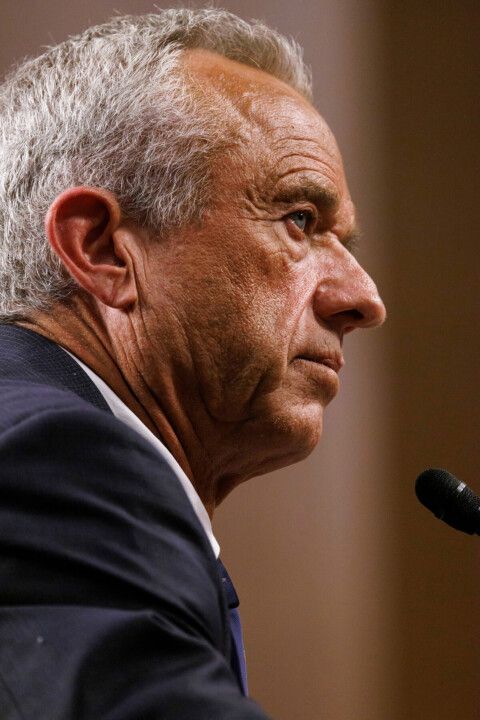
Health and Human Services secretary Robert F. Kennedy Jr.
3. Specialty care has gone mainstream.
It’s rare for a dental term to enter everyday language, but Invisalign has done just that: the first such lexicographical breakout since Novocaine. Its success reflects growing public comfort with orthodontics and implants. Aligners have made ortho more accessible to adults, while implants have become a reliable, long-term solution for tooth loss. The data support the trend. A 2024 Journal of the American Dental Association study found that the prevalence of dental implants among adults 50-plus rose from 1.3 percent (1999–2004) to 8.4 percent (2015-20). Orthodontic treatment volume per provider has also grown significantly, increasing 39 percent between 1996 and 2024.
4. Dentistry is hotter than ever.
The numbers are striking. Applications to U.S. dental schools rose from 7,770 in 2000 to 13,657 in 2025: a 76 percent increase, according to the American Dental Education Association. At the same time, acceptance rates have tightened, making admissions more competitive. This growing appeal reflects expanded career pathways—from independent practice to DSOs and community health centers—as well as rapid technological advancement. Fast-growing tools like intraoral scanners (in 2025, the largest dental lab in the U.S., Glidewell, reported that 68 percent of the impressions it received were digital, up from 7 percent a decade before) and CBCT imaging are improving both outcomes and professional satisfaction.
Four Challenges: Issues That Demand Attention Now
1. Oral health and research are under pressure.
Leading dental organizations rarely need to defend something as fundamental as federal oral health infrastructure. Yet recently, the Organized Dentistry Coalition (representing several national dental organizations including the ADA) urged Congress to reject proposed cuts to Health and Human Services oral health programs. More broadly, oral health policy is facing increasing scrutiny. Efforts to limit fluoride—whose efficacy is long supported by scientific evidence—are gaining traction at both federal and state levels, with ongoing regulatory reviews and state-level bans. At the same time, funding for basic research is stagnating. Inflation-adjusted investment in U.S. academic institutions by the National Institute of Dental and Craniofacial Research has declined more than 11 percent between 2002 and 2025. These trends pose a serious risk to long-term progress in oral health.
2. Access to care remains out of reach for too many Americans.
In 2022, an ADA Health Policy Institute analysis showed that dental care is viewed by patients as having a higher cost barrier than medicine, prescriptions or mental health treatment—one reason that a far higher percentage of American adults (85 percent, according to the CDC) see a medical provider each year than see a dentist (about 40 percent of adults, and just 52 percent of children, according to ADA HPI data). One painful result: roughly 2 million emergency room visits annually for dental problems.
Some solutions are emerging. States like Georgia are expanding teledentistry, and community health centers are serving more patients—reaching 6.8 million annually, a 20 percent increase since 2021. But gaps remain large. About 72 million adults lack dental insurance: almost three times as many as those who lack medical insurance, according to the CareQuest Institute for Oral Health. Cost continues to deter care, with nearly 20 percent of adults skipping dental visits in 2023.
~72,000,000
Americans lack
dental insurance.
That’s almost three times the number of those without medical insurance.
3. Mounting pressure on the dental workforce.
The cost of becoming a dentist continues to rise. Average tuition and fees for nonresident students at public dental schools hit $79,168 in 2025-26, contributing to average student debt of nearly $300,000. New federal borrowing caps add pressure, raising concerns about whether the profession will become less accessible, especially for those from underrepresented or lower-income backgrounds. Some schools are experimenting with accelerated pathways that reduce time to degree—but at higher total cost—prompting new questions about affordability and access.
These financial dynamics also shape where dentists practice. Research shows significantly higher dentist density in urban areas, while 24.7 million Americans live in shortage areas. At the same time, staffing shortages, especially among hygienists and assistants, are limiting practice capacity and are projected to worsen. Potential solutions include reducing education costs, expanding training pathways, supporting lending and leveraging technology to improve efficiency.
4. Productivity growth has slowed.
Dental productivity—measured as spending per dentist—rose steadily from 2001 to 2019, increasing about 28 percent, inflation-adjusted. Since then, progress has stalled. Productivity declined slightly during the pandemic, and despite a modest rebound in 2024, remains middling. Sustained gains will require investment in technology, workforce development, practice efficiency and fair reimbursement models. But framing productivity as primarily about dentist profitability misses the broader point: It is essential to improving patient access, enhancing efficiency and delivering better outcomes across the entire health system.
Everyone connected to dentistry—clinicians, educators, policymakers and business leaders—has a role to play.
The Path Forward
Who can step up—and how?
Gauging the state of dentistry isn’t simple. But one truth is clear: Progress will depend on people willing to step forward. Everyone connected to dentistry—clinicians, educators, policymakers and business leaders—has a role to play. Choose an issue. Get involved. Raise your voice.
That means different things for different parts of the profession. Dentists—pace Dr. Katherine Sislow—can push back more forcefully on insurers and advocate for fair reimbursement, most effectively by acting collectively through organizations like the ADA as it refocuses and reinvigorates itself (see “The ADA Faces Its Reckoning,” page 80). Educators and institutions can confront rising costs and expand pathways into the field, especially for underrepresented groups. Policymakers and professional organizations must defend science-based oral health policy and protect research funding—and all of us have a vote in who represents us in government. Plus, across the board, there’s an opportunity to expand access through teledentistry, community health centers, new provider categories like dental therapists and hygiene assistants, and larger facilities, while investing in the workforce and technology needed to treat more patients more efficiently.
Choose an issue. Get involved. Raise your voice.
As such, our ranking of this year’s 32 Most Influential People in Dentistry is skewed toward an assessment of influence as potential: the power these individuals have to shape the future of dentistry, if they choose to use it. Because influence, ultimately, is meaningful only when it’s exercised.
Dentistry has long been a powerful grassroots force. Now is the time to use it for the good of the profession and the patients we serve. As you read through our 32 Most Influential profiles, consider who is best positioned to drive change, who merits your support and how you can give it . . . and, finally,
where you can step in to help close the gaps.
CHARLES COHEN has been leading 1930 Ventures (a family holding company) and Benco Dental, publisher of Incisal Edge, for more than 30 years. In that time, he has helped guide its evolution from a regional supplier into America’s largest independent dental distributor and a leader in consumables, technology, practice design and consulting.

 LOADING FORM...