
More than three years after Incisal Edge first covered the fight over Question 2, Massachusetts’s experiment in dental insurance reform is inspiring similar moves nationwide—and early data is prompting cautious optimism among dentists.
By Mark Caro
 IN NOVEMBER 2022, Massachusetts’s Question 2 referendum passed by a thunderous 72-28 margin, upending the way dental insurance providers allocated their money. The activist orthodontist who introduced the measure, Dr. Mouhab Rizkallah, giddily declared a revolution had begun.
A few months later, we put Dr. Rizkallah atop our 2023 list of the 32 Most Influential People in Dentistry, citing his “stalwart defense of his principles, as well as his success at the ballot box.”
Dental insurers didn’t wave the white flag. Mike Adelberg, executive director of the National Association of Dental Plans (NADP), a benefits trade group, predicted that once the law’s adverse consumer effects emerged, the argument against nationwide spread of such measures “will get a lot stronger.”
More than three years since the referendum’s passage—and more than a year after the January 2025 implementation of the law—debate rages. Other states have followed in Massachusetts’s footsteps to varying degrees, while most of the country still has not yet adopted its model. In the Bay State itself, industry experts are only starting to tabulate and analyze the data.
A Revolution Stirs
Still, James Schulz Jr., the American Dental Association’s senior vice president for government and public affairs (see No. 1, page 41), sees momentum building for insurance reform measures such as the Massachusetts law, which the ADA backed. “There’s a newfound energy across the country for people to know where their premium dollars are going,” he says.
What the Massachusetts law did was establish the dental equivalent of the medical loss ratio (MLR) mandated in the Affordable Care Act under President Barack Obama. That law requires that medical insurers spend a minimum of 80 percent of revenue on claims, treatment and quality relative to administrative costs. Massachusetts sets its own MLR at 88 percent.
Question 2 established the country’s first dental MLR and set it at 83 percent. Dr. Rizkallah trumpeted the need for such a ratio by citing the 2019 not-for-profit
tax filing from Delta Dental of Massachusetts, the state’s dominant dental insurance provider, showing that it had spent $177 million on patient care that year yet contributed $291 million to its parent company. Under the new law, providers that failed to meet the 83 percent threshold would be required to give
rebates to the consumers who paid into the system.
Where the Movement Is Spreading
Dr. Rizkallah now uses the term “dental loss ratio,” as he sees his concept catching on nationwide. “Dental loss ratio is the buzz,” he says. “It has now been introduced in over 25 states. Meaningful dental loss ratio is effective at bridling the insurance companies.”
Although many states are indeed weighing the concept, the number that have set a dental loss ratio into law is relatively small. Dr. Sara Ehsani, a member of the ADA’s Council on Advocacy for Access and Prevention, notes that Nevada, New Mexico and North Dakota have all implemented loss ratios at lower figures than that of Massachusetts: Nevada’s 75 percent and New Mexico’s 65 percent are both already in effect; North Dakota’s, which takes effect July 1, 2027, will be 75 percent. “Other states have adopted some of the framework,” Dr. Ehsani adds. The Austin, Texas–based dentist cites Arizona, Colorado, Maine, Louisiana, Rhode Island, Montana, Virginia and Washington as those that require insurers to provide loss-ratio reporting and fee transparency.
Dr. Rizkallah takes issue with how some other states’ laws have been implemented. “Nevada is the best one I’ve seen, but all of them have complications and problems,” he says. His biggest complaint is a loophole that allows insurers to classify large sums of non-treatment money as “charitable contributions.” Dr. Rizkallah blames the ADA for approving in April 2024 a national DLR model, based on its work with the National Council of Insurance Legislators (NCOIL), that allowed this and other ways for insurers to manipulate the numbers. The ADA’s House of Delegates repealed this model in August, Dr. Rizkallah says, but problems linger. “The only [state] that closed out ‘charitable contributions’ is Nevada,” he says, adding that he wishes its DLR were higher than 75 percent.
With little possibility of national legislation to implement sweeping changes to the dental insurance industry, each state must set its own path. “There is no absolutism in the process of making laws,” Schulz says, noting that the ADA’s job is to work within each state’s specific legislative priorities rather than to impose a uniform solution.
NADP’s Adelberg says insurers worked with Nevada and New Mexico to establish their loss ratios. “The numbers are based on reasonable practice in those states and were arrived at after several cycles of carriers and regulators looking at numbers together,” he says. “NADP does not oppose reasonable, gradual approaches.”
By contrast, he argues, Massachusetts’s loss ratio of 83 percent “was completely arbitrary and had a negative impact on carrier participation.” He is also critical of North Dakota’s establishment of a 75 percent loss ratio. “It’s a less obnoxious number [than Massachusetts’s], but they picked a number arbitrarily, and that’s what we oppose.”
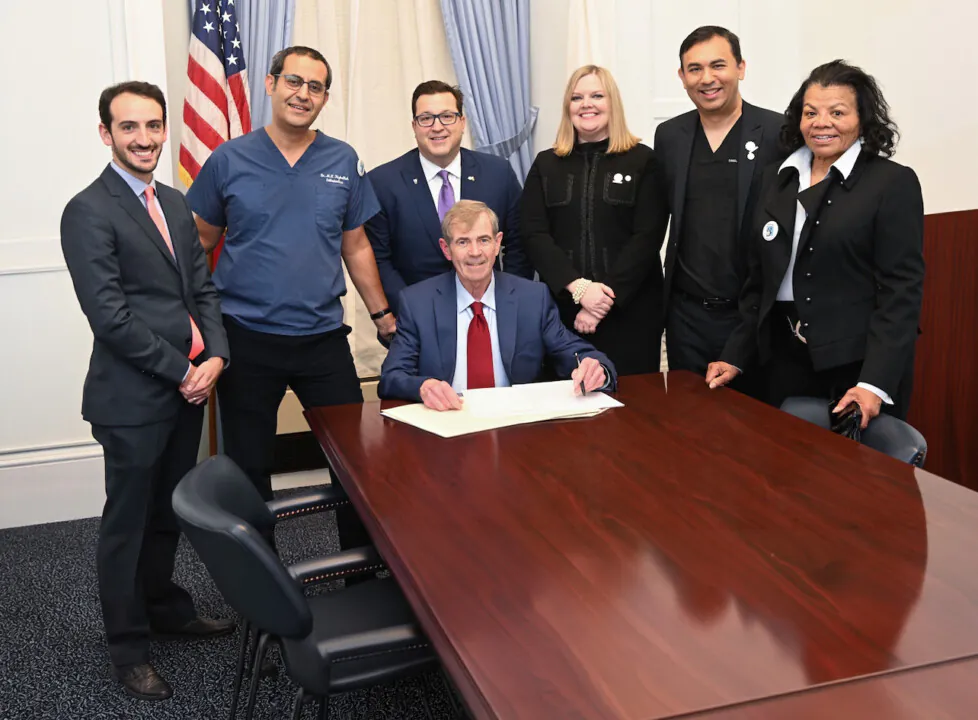
On the dotted line: Dr. Mouhab Rizkallah (second from left) with other dentists and Massachusetts Secretary of the Commonwealth William Francis Galvin (seated) in December 2022, celebrating the passage of Question 2 in a statewide referendum.
“Dental loss ratio is the buzz. It has now been introduced in over 25 states. Meaningful dental loss ratio is effective at bridling the insurance companies.”
How the Numbers Look Now
Both sides now wait for definitive data to show the impact of the changes. Dr. Rizkallah notes that the law “didn’t fully activate in January 2025” because the reporting template “wasn’t formulated until the middle of 2025.” Early returns are encouraging, he says, citing an ADA Health Policy Institute research brief published April 5, 2026. Coauthored by Kaymar Nassaeh and Marko Vujicic (see No. 1, page 41), the study finds that “allowed prices for dental procedures increased 5.2 percent, and the insurer discount applied to submitted charges declined 2.8 percentage points relative to the comparison states.” Its conclusion: “Prior to full implementation of the dental loss ratio requirement in 2025, dental insurers in Massachusetts increased reimbursement to dentists to possibly meet the required dental loss ratio threshold.”
Dr. Rizkallah says the study also reports that dental insurer payouts elsewhere in New England declined over the same period. “Neighboring New England states actually went down in reimbursement, whereas Massachusetts went up,” he says. “What it shows is a meaningful dental loss ratio doesn’t just have the effect of elevating spending. It also protects against lowered spending. It’s not just a sword; it’s a shield.”
Adelberg says that while his group awaits more conclusive info, “we know that a number of [insurance] carriers left the small group market in Massachusetts. Some left the individual market. There were drops. Others stayed but zeroed out broker commissions.”
Schulz stresses that the loss ratio debate “is part of this larger conversation about dental insurance reform.” Other efforts include proposed legislation to remove the preemption that prevents state laws from applying to self-insured dental plans covered under federal law. Dr. Ehsani cites bills, such as one passed in Maryland, to stop insurers from “downcoding” procedures and causing dentists to be reimbursed for less expensive procedures than the ones performed.
In the meantime, Schulz says, 29 bills related to loss ratio have been introduced in state legislatures, with more than a dozen enacted. “What Massachusetts did is start a dialogue that had not been started nationally,” he says. “That, from my lens, is success.”

 LOADING FORM...