

When DEXIS set out to create the Imprevo intraoral scanner, the goal wasn’t simply to improve upon existing technology. It was to rethink the entire scanning experience.
BY EDWARD KOBESKY. PHOTOGRAPHS COURTESY OF DEXIS
THERE’S A LOT riding on the new Imprevo Scanner—for DEXIS and users alike. As the company’s first all-new product since it absorbed Carestream Dental’s scanner business in 2022, and the first developed entirely in-house, expectations are high. Will it exceed the legacy models’ reputation for performance, seamless software integration and workflow flexibility? The short answer is, in today’s competitive market, it must—and it does.
Many dentists appear to be holding off on their next scanner purchase—not because of disinterest but for lack of something they find sufficiently compelling. According to Incisal Edge’s most recent Innovation Index Report, Benco Dental’s scanner sales dropped 10 percent year over year—even as CAD/CAM mills and 3D printer sales surged by 48 percent and 24 percent, respectively. On paper, the Imprevo may be just what the doctor ordered: a clean-sheet design from a company that acquired and expanded one of the scanner sector’s top R&D teams. So far, both users and our in-house experts are impressed.
A New Kind of Speed
The Imprevo’s performance specs and litany of improvements are impressive—but how DEXIS achieved them is especially interesting. Take the 40 FPS frame rate: It not only boosts data density in the final mesh but also contributes to a smoother, more seamless scanning experience. How? That’s largely due to DEXIS’s industry-first use of GPU-based parallel processing in dental intraoral scanning, instead of the conventional CPU approach.
“CPUs are built for general-purpose computing and are relatively easy to program,” explains Emma Liu (above), the Imprevo’s R&D director and a member of the former Carestream Dental team now at DEXIS. “But their performance is limited when handling large volumes of data.” By contrast, GPUs—originally designed for rendering 3D graphics—have evolved into powerful tools for parallel computation. “It’s a relatively young technology compared to CPUs, nicknamed ‘accelerated computing.’ ” The difference, for a lay audience, is that “CPUs consist of very few independent internal cores, while GPUs consist of thousands or even tens of thousands of independent cores suited for simple arithmetic computations.” Liu says that translates to a time cost less than 10 percent of a CPU.
Sharper Scans, Smarter Optics
As the old saying goes, “garbage in, garbage out.” Processing power means little without high-quality image capture—and that’s where the Imprevo’s new optical module shines. It combines blue laser precision with white LED lighting, dual sensors and multiple optical lenses to achieve that 40 FPS capture speed, producing a denser 3D point cloud and deeper depth of field. This approach also responds directly to user feedback from earlier models, delivering clearly better soft-tissue textures.
“A lot of work was required around this part,” says Mike Dennehy, IOS senior global product manager at DEXIS. While optical modules often get the spotlight, he emphasizes that the bigger challenge was in developing GPU-based acquisition and rendering algorithms. “Our team tackled incredibly complex, groundbreaking programming to make it happen.” The numbers don’t lie: This combination means that the Imprevo’s 40FPS speed is twice that of the prior-generation IS 3800, with a 39 percent depth of field increase.
Designed with Dentists
DEXIS conducted extensive voice-of-customer research to understand clinicians’ needs and frustrations. Their feedback directly shaped features like the slimmer handpiece (20 percent thinner than previous generations), a smaller autoclavable tip profile (retaining the same field of view) and gesture-based smart controls (for touch-free operation and improved hygiene). “The key is fully identifying what users are trying to achieve, then testing potential solutions, multiple times if needed,” Dennehy says. Liu adds that beta testing is another crucial component because “it helps us identify numerous issues that are difficult to detect within R&D testing environments.”

From sketch to scanner:
DEXIS strives for smartphone-level industrial design, and users say it delivers. “The Imprevo scanner delivers immediately conveys a sense of solidity and confidence while maintaining excellent handling,” says Dr. Carlo Massimo Saratti.

Designing in millimeters:
R&D head Emma Liu says achieving smaller, smarter design means optimizing the layout of optical elements for maximum space efficiency. “There are many small but mighty innovations in this area, such as sensor location and light path folding.”
One area that needed little improvement was DEXIS’s ScanFlow software, now in version 2.0. Users have consistently praised its open and flexible nature for anyone using STL files—which is to say nearly everyone. (It also shares direct integration with SprintRay but works with any printer that is STL-compatible.) As you’d expect, ScanFlow software connects seamlessly with DEXIS Imaging Suite, DTX Studio Clinic and DEXIS IS Connect Cloud, making it easy to navigate and share scans.
Several essential components—including the CMOS sensor, FPGA chip and Wi-Fi chip—are advancing swiftly thanks to industries like consumer electronics and automotive.”
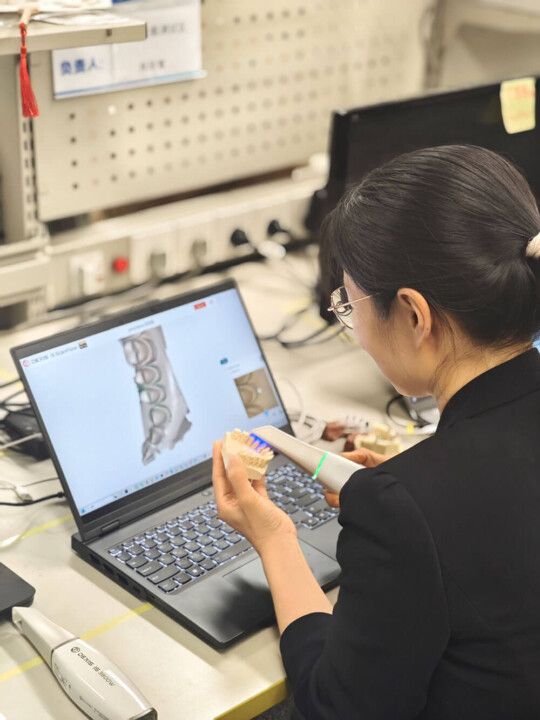
Proven in practice: Testing starts in the lab but extends to real-life conditions with actual dentists. “Their feedback was instrumental to enhance our hardware design, scanning process and interface optimization,” Liu says.
A Global Vision for the Future
According to Liu, more than 100 people around the world contributed to the Imprevo project—including roughly 20
engineers in Shanghai focused on software, algorithms and UI/UX testing, a software team in Paris and partners like Dennehy supporting marketing, training and operations. Their jobs are never really done. “We operate a continuous improvement model so everything, particularly the software, is continuously being developed, honed and improved,” Dennehy says. “New features are added frequently alongside improvements that assist with accuracy, reliability and usability.”
So what’s next? “Customers increasingly expect new scanners to feature a more compact design and enhanced performance,” Liu says. “Several essential components—including the CMOS sensor, FPGA chip and Wi-Fi chip—are advancing swiftly thanks to industries like consumer electronics and automotive.” She downplays cost as the primary constraint, instead emphasizing the compromise among weight, size, performance and price. “It’s a significant and ongoing challenge. We’ve dedicated time to building the organization and adapting to new processes and tools.”
In the end, DEXIS didn’t just launch a scanner—it built a foundation for continuous innovation, one designed to perform at the highest level today while evolving even more gracefully than its most trusted legacy products.

 LOADING FORM...