

Dr. Lewis Balamuth
circa 1906–circa 1981
Prolific innovator in applied ultrasonics; co-inventor of the first ultrasonic handpiece.
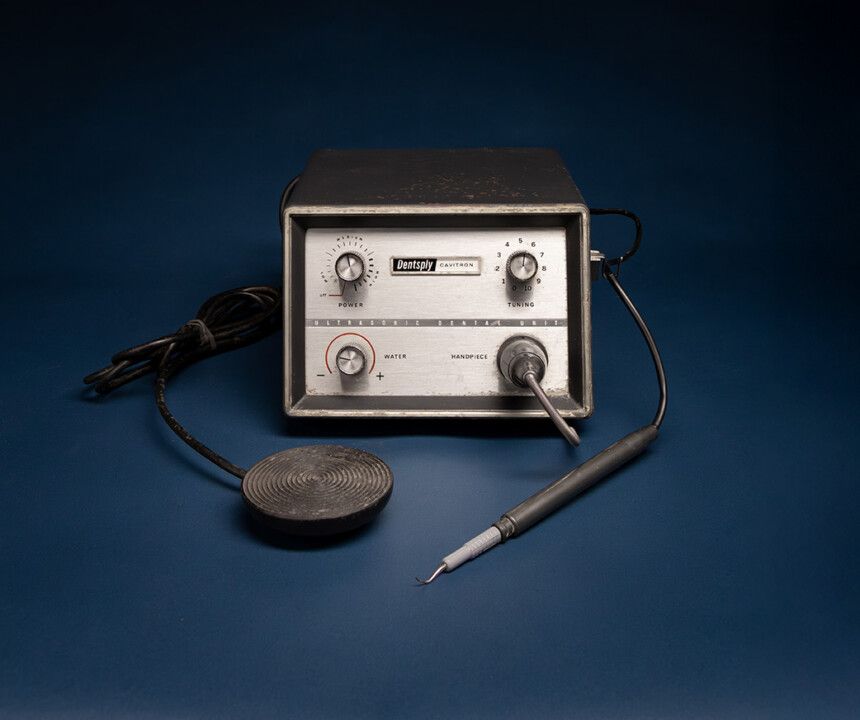 LEWIS BALAMUTH WASN’T the sole inventor of the Dentsply Cavitron Model 660, the first commercially viable, widely adopted ultrasonic dental unit, and the predecessor of today’s scalers. As the company’s head of research, he collaborated closely with ultrasonics engineer Dr. Claus Kleesattel and engineering chief Arthur Kuris. Still, because Balamuth devoted nearly his entire career to advancing ultrasonic technology, particularly in dentistry, he merits solo induction as the twenty-fifth member of our Dental Innovators Hall of Fame.
Introduced in 1963, the Cavitron Model 660 changed the game. “The patient who used to wince at the scraping of the old hand scalpel on his teeth can now relax,” reported the New York Times, praising the device for its “painless removal of tartar and stains.” With a price around $800—roughly ten times that in today’s dollars—it was hardly inexpensive, but groundbreaking technologies rarely are. What stands out most is how quickly it was adopted and how that early momentum paved the way for both incremental technological advancements and economies of scale in today’s accessible ultrasonic scaling systems. Consider this: Dentsply Sirona’s current Cavitron 300 Series retails for about $4,000, about half the original’s inflation-adjusted price.
At the most fundamental level, though, surprisingly little has changed since the original unit. Balamuth’s Cavitron operated at about 25K (25 kilohertz, or 25,000 cycles per second), while modern scalers more commonly run at 30K, which many clinicians prefer for quieter, smoother operation. Still, plenty of companies continue to support 25K units, evidence that Balamuth and his collaborators got the essentials right from the beginning. The biggest differences are in ergonomics: Modern devices are far smaller, lighter, quieter and equipped with handpieces that are considerably easier to maneuver.
Balamuth earned his Ph.D. in physics from Columbia University in 1934, focusing on the use of ultrasound to measure the elastic constants of crystals. He later joined the faculty at City College of New York but resigned in 1941 following accusations of alleged communist sympathies, according to the Smithsonian Institute, which houses a Model 660 in its collection.
Academia’s loss was clearly private industry’s gain. Balamuth quickly became a leading figure and a veritable patent machine, securing around 90 in all, most related to ultrasonic motors, dental instruments and surgical devices.
Beyond those accomplishments, however, surprisingly little personal information survives, not even a definitive date of birth. The Smithsonian lists Balamuth’s birth year as 1906, while Social Security records suggest he was born December 31, 1905; it might simply have been rounded into the next year. Whether he married or had children isn’t widely documented, nor is the exact date of his passing, though Social Security records again point to 1981. We should know more about someone whose work so profoundly shaped modern dental technology. We therefore celebrate Balamuth’s achievements in these pages and welcome him among august company.
Previous Inductees
- 2025: Percy R. Howe
- 2024: Dr. Dan Fischer,
Dr. Dominick DePaola - 2023: Dr. Stanley F. Melamed,
Otto E. Lienhard - 2022: Dr. Edward F. Rossomando,
Dr. John A. Molinari - 2021: Richard Saslow,
Anne Eiting Klamar - 2019: Esther Wilkins
- 2018: Dr. Francis Mouyen
- 2017: Dr. Rafael Bowen,
David Schick - 2016: Dr. Richard Pelton,
Ernest Crane,
Dr. Gordon J. Christensen - 2015: Dr. Robert Meyer,
Lucy Hobbs - 2014: Dr. Jack Dillenberg,
Dr. Howard Farran - 2013: Dr. William B. Dragan,
Dr. John V. Borden - 2012: Dr. Joshua Friedman,
Jim Glidewell

 LOADING FORM...