

THE NEW THINKING IN IN-HOUSE LABS
How ultra-advanced practices such as Garine & Boza Prosthodontics build a right-sized internal lab—and how other ambitious dental offices can follow their lead.
BY EDWARD KOBESKY
VERTICAL INTEGRATION IS crucial anywhere control, precision and predictability matter. But smart implementation no longer means owning every link in the chain. It means selectively taking control of the technologies and digital production steps that most influence clinical outcomes. Large industries have entire R&D departments for this; dental practices don’t. That makes it even more important for ambitious owners and managers to be strategic about what they bring in‑house and when. So how should forward‑thinking perfectionist practices build or upgrade an in‑house lab without overextending? Garine & Boza Prosthodontics, with multiple locations in South Florida, offers a real‑world road map.
Founded by Dr. Wael Garine, joined later by partner Dr. Luis Boza, Garine & Boza Prosthodontics has witnessed the full arc of digital change. As its clinical team leader and digital designer, Guadalupe Carrizales, recalls, “When I started, I had to take alginate impressions pre-surgery, pour it, clean up the model and send for immediate restorations in hopes the lab would meet the surgery date. Now we take a quick scan, design and mill same day if the situation calls for it.” For her, prosthodontics has always been defined by creative problem‑solving. It also reveals a side benefit of tech adoption: the shot of energizing and infectious intellectual adrenaline it delivers. “Some days I get to feel the thrill of Indiana Jones.”
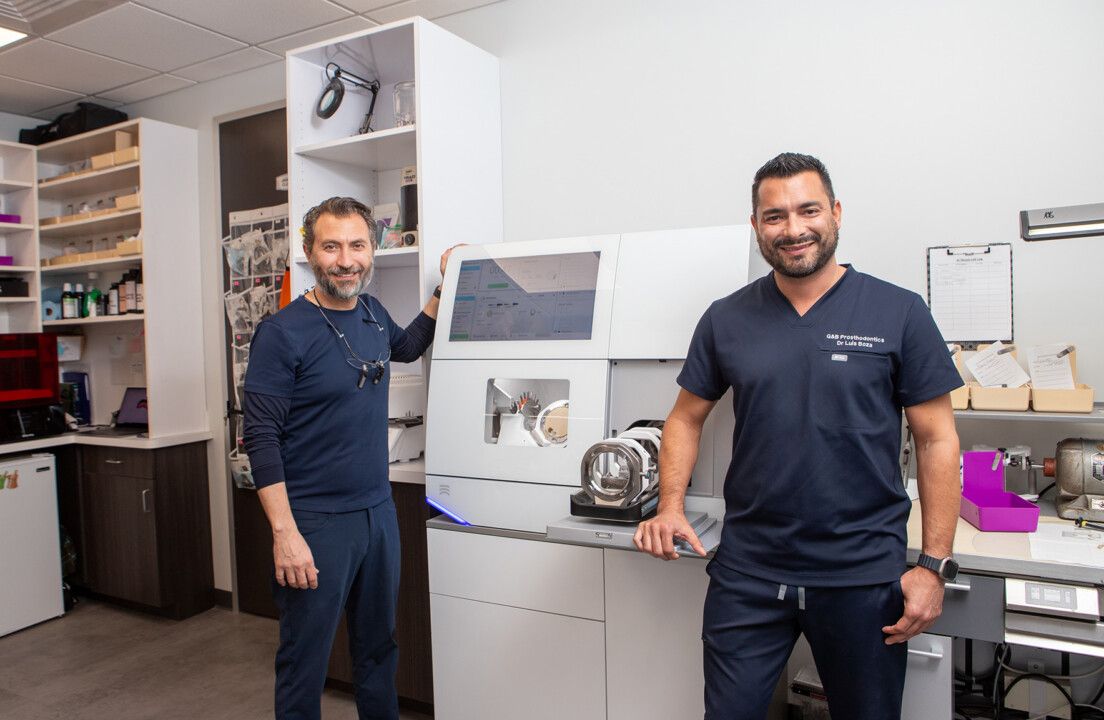
Drs. Wael Garine (left) and Luis Boza
Building for Scale, With Intention
The practice started with a small lab in each location for temps and dentures, but as technology matured, their strategy evolved. “We bought three 3D printers from which we print all our nightguards, models and some all-on-X prototypes. Then we purchased a milling machine, and we’re doing PMMA prototypes, lithium disilicate posterior crowns, complete dentures—and much more in the future,” Dr. Boza says. “Today it’s a central in‑house lab, but this might change.” The progression wasn’t sudden. Theirs was a series of measured upgrades based on capability, need and timing.
The doctors’ carefully calibrated boldness reflects a core philosophy. While Garine & Boza Prosthodontics is known for early adoption, Dr. Boza frames it with pragmatism, cautioning that “early adoption comes with a big risk.” The payoff? “We pay a premium at the beginning, but when we dominate the work protocols, we can be much more efficient with our time and materials.” Carrizales is clearly part of fostering this culture. “The learning curve is the fun part,” she says. “We never stop learning. It’s what makes our practice stand out.”
Even with that culture, adoption is never impulsive. Instead of chasing every new tool, the partners continually evaluate their workflow, looking for bottlenecks and opportunities to improve predictability. They review clinical protocols annually to pinpoint which technologies truly elevate outcomes and hold quarterly staff meetings to prepare the team for changes. Their earlier steps were intentionally modest. “Our primary goal was to be able to make our own designs for full-mouth rehabilitations and be able to control the outcome, so PMMA was our only goal,” Dr. Boza recalls. “We were able to expand that in our first three months.”
The People Factor
“I value mentorship as part of the growth mindset that we embrace in the practice,” Dr. Garine says. That’s especially important because training and staffing represent their biggest ongoing challenge. They got lucky when clinical team leader Carrizales stepped up and added lab stewardship to her duties. Dr. Boza still participates, but far less intensively. “At the beginning it was at least one hour a day, but now I just help to make sure we have all that’s needed for the week, usually no more than three hours each week.” Creating expertise from within not only reduced costs but also ensured that lab operations remained aligned with the practice’s clinical philosophy.
Physical space was another hurdle, and remains so. “Most of our practices weren’t built to have lab space,” Dr. Boza adds. “That’s why I think it’s very important to have a good consultant from the company [that supplies your tech].” Even when lab space was built into one of their floor plans, adjustments were required. “We’ve lucky that the space has been enough for our growth.”
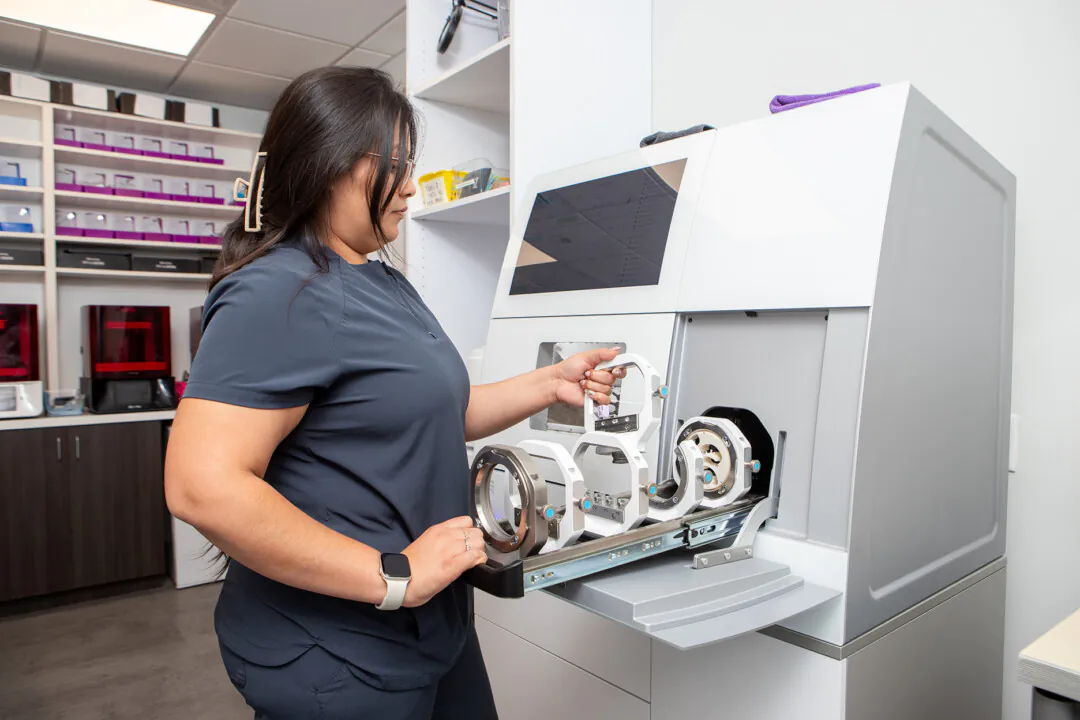
Home cooking:
Digital designer Guadalupe Carrizales believes integrating AI into workflows “will cause a rise in clinicians finding they can restore more cases in-house, with a well-trained assistant and a bit of initial investment in equipment.”
The Precision Advantage
Is the biggest benefit efficiency or control? “Both!” Dr. Boza exults. “When we use outside labs, we’re bound to two to three weeks. When we do our own, the digital workflow allows us to deliver great results in shorter times, usually on the same day or within 48 hours. Being able to control the esthetics and other technical parts is imperative.”
They take a similarly strategic view on equipment lifespan. “We’re thinking they’re good for at least five years,” he adds. “I’m sure you can use them for ten years or more, but technology might be more advanced and begin to make them obsolete.” The practice’s milling platform has been especially useful. “It can mill any material you want, and we can plan it to mill nonstop all night with different materials.” They’re realistic about what still belongs outside their walls, though. “I don’t think commercial labs are anywhere near obsolete,” Dr. Boza says, “though I do see a lot more ‘niche’ labs growing.”
Looking back, he says, “most of the technologies have given us what we need.” The doctors are bullish as ever on early adoption, with far more nuanced ROI expectations than merely money. “Some might be difficult to quantify, like new AI for writing notes. It’s difficult to say that we’re breaking even or losing, but it frees my assistants and me from spending more time typing—freeing us to do something more productive.”
In the end, the biggest takeaway is about mindset: Resisting change means falling behind. “If you don’t embrace it, you’re stagnant and going backward,” Dr. Boza says. “If you decide to stay with the same technology, you must be ready in the next five to ten years to become obsolete.” Garine & Boza Prosthodontics proves that an in‑house lab isn’t a monolithic investment but rather a staged evolution. When handled deliberately, each step pays dividends in dramatically improved precision, efficiency and patient experience.


 LOADING FORM...