
Delivering reliability, convenience and value with the Premier X5 Sectional Matrix System
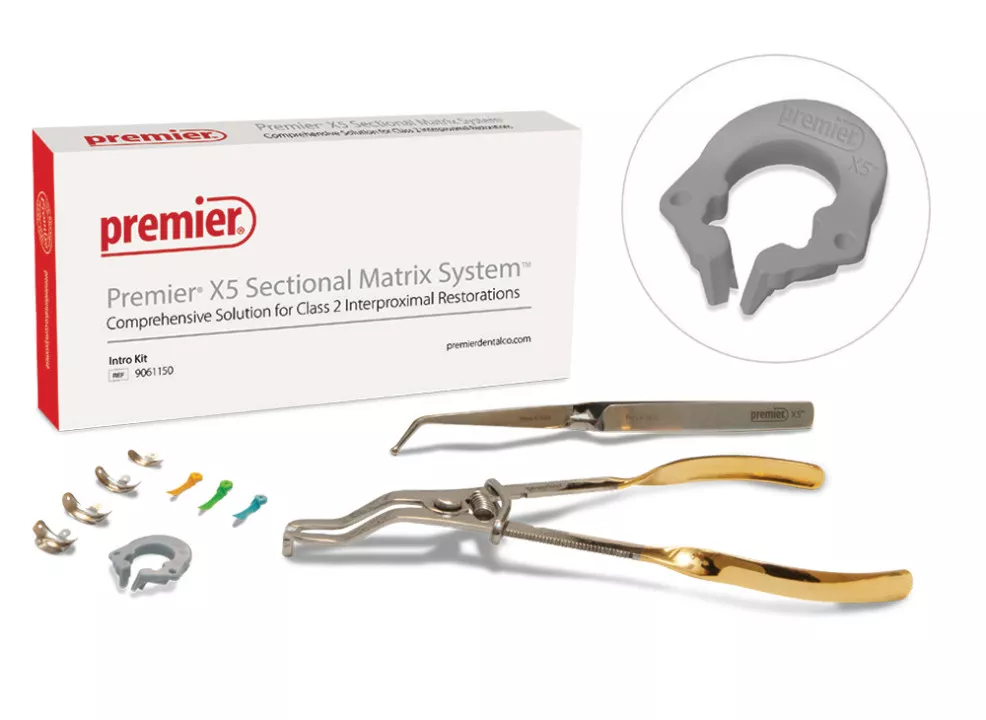
Figure 1: Premier X5 Sectional Matrix System™ (Premier® Dental Products)
The gold standard for isolation of the working field prior to a composite resin restoration is placement of a rubber dam.(1) The creation of a drier environment, improved access, and increased infection control are just a few of the potential benefits; however the use of rubber dam isolation is not commonplace.(1,2) In a recent meta-analysis including 539 clinical trials, it was the author’s conclusion that composite restorations performed best after placement under rubber dam.(3)
In the case of Class 2 composite restorations, isolation of the prepared interproximal box with a matrix system is needed for successful placement. Not only does the selected matrix system need to seal the preparation to help achieve marginal integrity, it needs to mimic natural tooth contour and facilitate interproximal contact.(4) Historically, circumferential matrices (e.g., Tofflemire-type) have been used but have inherent limitations. While effective in sealing the preparation, standard Tofflemire-type matrix bands provide little help in creating proper interproximal contact, both in the shape and position of the contact or the actual strength of contact, all of which influence the potential for food impaction.(5,6) In addition, Tofflemire-type retainers can be uncomfortable for the patient. It was not until 1986 that the first sectional matrix system was introduced (i.e., BiTine Sectional Matrix System, Darway Inc.)(7 )
Recently, the Premier X5 Sectional Matrix System™ was introduced as a complete, high-quality, five-component system designed to achieve accurate Class 2 composite restorations. (8) (Figure 1) The X5 system is designed to overcome the inadequacies of the circumferential matrix and the shortcomings of the BiTine system (i.e., seating and stabilizing the ring, preventing the ring from collapsing the matrix on a wide bucco-lingual prep). The five components of X5 are: resin separating rings capable of separating the teeth and sealing the matrix; anatomically-shaped matrices to help proper contouring in 4 sizes; wedges in 3 sizes; matrix ring forceps; and matrix pin tweezers.
Existing sectional matrix systems include metal separating rings either made from nickel titanium or stainless steel. While effective, if these metal rings get lost, damaged, or corroded they are expensive to replace. Because of the cost of metal sectional matrix rings, usually $120 or more, practices may not stock enough of them to handle the needs of multiple clinicians restoring Class 2’s in multiple operatories. To address this issue, each Premier X5 kit comes with ten resin rings, and they can be reordered in bags of 35. Made from a proprietary resin, the X5 rings are flexible for easy placement, yet have been tested to deliver comparable separation strength to metal rings.
The resin rings are the better value choice when integrating a sectional matrix into your restorative armamentarium. At approximately $4 each, the resin rings can be autoclaved and reused up to five times. Besides anatomic matrices to help develop contour, the success of a sectional matrix system is related to the ring’s ability to separate the teeth to help create proper interproximal contact. After five uses, the X5 ring should be discarded, and a new ring used to ensure predictable tight contacts.
Case Example
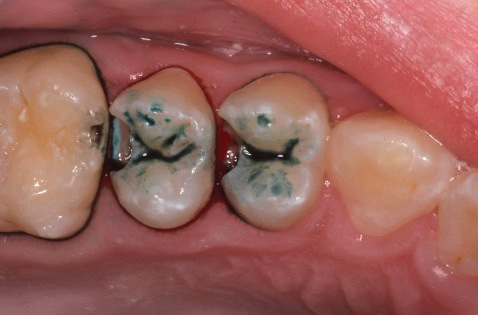
The Premier X5 Sectional Matrix System can be used to restore a single interproximal area, MOD-type restorations, and multiple teeth within a quadrant. In this case, an 18-year-old male patient presented for direct restorations on the disto-occlusal areas of teeth Nos. 12 and 13. After successful local anesthesia via infiltration injection, the preparations on teeth Nos. 12 and 13 were completed and caries removal was verified. (Figure 2)
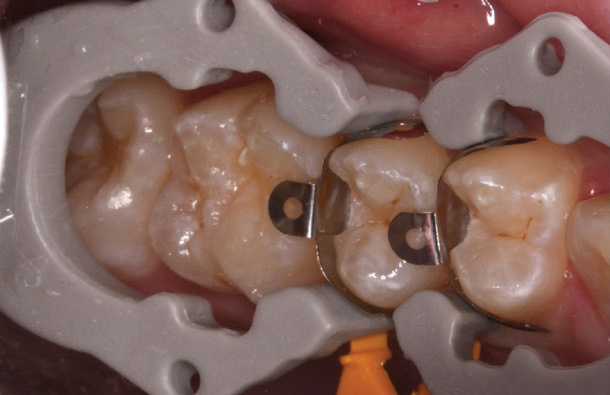
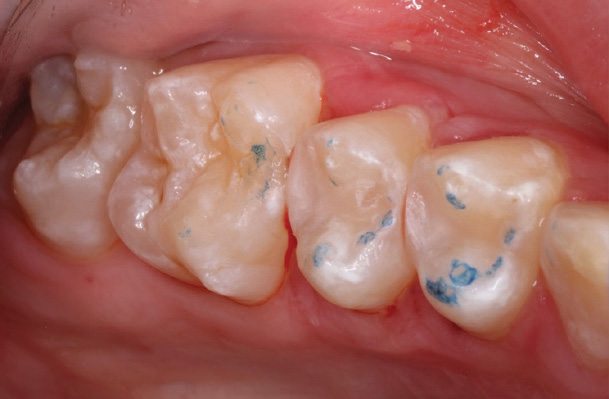
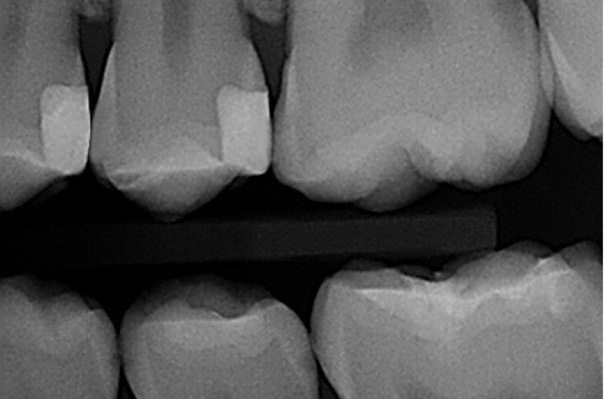
Both preparations were isolated with the X5 system by first placing the metal matrix, the wedge, and then the ring. (Figure 3) The teeth were restored using a selective etch bonding technique, universal composite, and LED curing light. After removing the X5 components the restorations were adjusted with a fluted carbide finishing bur and proper occlusion was verified. (Figure 4) Finally, during a follow-up hygiene exam the completed restorations on teeth Nos. 12 and 13 are visualized and showed excellent interproximal contact and contour. (Figure 5)
-
- Figure 2: Caries indicating solution on the completed preparations, before rinsing, of teeth Nos. 12 and 13.
-
- Figure 3: Teeth Nos. 12-DO and 13-DO isolated with the X5 system. Each ring in this case is seated interproximally and sealing the matrix band bucco-lingually. The wedges are sealing the gingival margins of the interproximal boxes.
-
- Figure 4: The completed restorations on teeth Nos. 12-DO and 13-DO. Note the excellent marginal ridge form and well-developed occlusal embrasures.
-
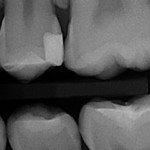
- Figure 5: Post-operative bitewing radiograph showing excellent interproximal contour and contact.
Closing Thoughts
Resin composite restoration of Class 2 preparations is very common in everyday dental practice. Consistent positive outcomes require tools and techniques that promote efficiency, specifically allowing the clinician to work confidently but also produce outstanding Class 2 restorative results every time. To recap, the five reasons to consider the new Premier X5 Sectional Matrix System are:
- Featuring strong, proprietary resin rings that are reusable up to 5 autoclave cycles
- Anatomically-shaped matrices to promote proper interproximal contouring and tight contacts
- Other system’s wedges and matrices are compatible with the X5 ring
- The X5 system is easy to use for Class 2 composite restorations compared to Tofflemire-type retainers
- Priced right for exceptional value, the X5 system helps to provide the results clinicians want and that patients need.
REFERENCES:
- Hill EE, Rubel BS. Do dental educators need to improve their approach to teaching rubber dam use. J Dent Educ 2008;72(10):1177-81.
- Gilbert GH, Litaker MS, Pihlstrom DJ, Amund-son CW, Gordan VV. Rubber dam use during routine operative dentistry procedures: findings from The Dental PBRN. Oper Dent 2010;35(5):491-9.
- Heintze SD, Rousson V. Clinical effectiveness of direct class II restorations – a meta-analysis. J Adhes Dent 2012;14(5):407-31.
- Shuman I, excellence in class II direct composite restorations. Dent Today
2007;26(4):102, 104-5. - Kurtzman GM. Improving proximal contours for direct resin restorations. Dent Today 2010 Apr;29(4):106, 108-9.
- Strassler HE, Trushkowsky RD. Predictable restoration of Class 2 preparations with com-posite resin. Dent Today 2004;23(1):93-9.
- Karst LE. The elusive tight contact with com-posite restorations. How to achieve it. Dent Today 2003;22(11):6-9.
- Premier X5 Sectional Matrix System. Available at: http://www.premierdentalco.com/prod-uct/restorative/matrix/matrix-system/pre-mier-x5-sectional-matrix-system/. Accessed September 8, 2021.
ACKNOWLEDGEMENT : Special thanks to Troy Schmedding, DDS for photographing the clinical case presented in this article.
 Jason H. Goodchild, DMD received his undergraduate degree from Dickinson College in Carlisle, Pennsylvania. He went on to receive his dental training at the University Of Pennsylvania School Of Dental Medicine (Philadelphia, PA). He is currently the Vice President of Clinical Affairs at Premier Dental Products Company (Plymouth Meeting, PA) involved in developing innovative new products and educating clinicians to improve clinical practice. He is also Associate Clinical Professor in the Department of Oral and Maxillofacial Surgery at Creighton University School of Dentistry (Omaha, NE), and Adjunct Assistant Professor in the Department of Diagnostic Sciences at the Rutgers School of Dental Medicine (Newark, NJ). He can be reached via email at: jgoodchild@premierdentalco.com

 LOADING FORM...